
CMS Publishes NGHP User Guide Version 8.6

by F. Fairchok
The Centers for Medicare & Medicaid Services (CMS) published an update to the Non-Group Health Plan (NGHP) Section 111 Reporting User Guide on October 5, 2026. User Guide, Version 8.6 contains policy clarifications in Chapter III, two technical changes taking effect in April 2027, and updates to the system-generated emails sent to Responsible Reporting Entities (RREs).
System-Generated Emails
Chapters I, II, and IV state that emails coming from [email protected] will now show the sender’s address as [email protected]. Replies are not monitored by the Benefits Coordination & Recovery Center (BCRC), so questions should go to the RRE’s assigned Electronic Data Interchange (EDI) Representative instead.
Chapters II and IV also add a non-submission notification email, sent to the Authorized Representative and Account Manager when an RRE has not submitted a Claim Input File within the last six months. Table 6-4 in Chapter II references this new notification:
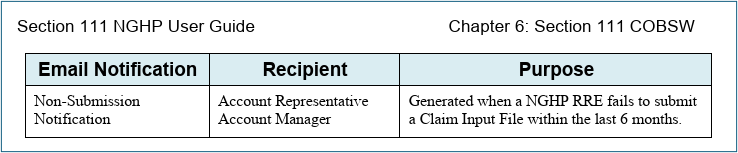
Note: The table shows “Account Representative” which is an error in the edit, and it should read “Authorized Representative”.
Wrongful Death and Qualified Settlement Fund (QSF) Clarifications
Chapter III, Section 6.5.1.4 clarifies when a wrongful death record must be submitted as follows:
“Wrongful Death – Many states allow for the recovery of medical expenses from the proceeds of a wrongful death settlement, judgment, or award. Further, oftentimes, a complaint alleging the wrongful death theory of liability, and the settlement documents related to an alleged wrongful death cause of action, are written in such a way that medicals are claimed and released or have the effect of being released, whether or not the parties intended that result. As such, RREs are required to report any wrongful death settlement unless the RRE is able to definitively determine that all relevant documents, state law, and common law, do not permit for the recovery of medical expenses from the payment being made and that medicals were not released or had the effect of being released.”
Chapter III, Section 6.5.1.8 updates the language to clarify the reporting exception for Qualified Settlement Funds (QSF). The new language added is as follows:
“For TPOCs that were paid into a QSF after October 1, 2011, by entities that would otherwise be considered RREs, in situations where there are multiple entities funding the QSF, and multiple claimants receiving settlement funds from the QSF, such that it would be impossible to know precisely how much of each entity’s contributed funds were allocated to each claimant, then the QSF may be permitted to operate as the RRE, where permitted by law, provided that the following conditions are met:
-
-
-
-
-
- The QSF opts to take on the role of an RRE for purposes of mandatory insurer reporting obligations; and,
- There is no active ORM; and,
- There are two or more entities funding the QSF; and
- The QSF is operating under Section 468B of the IRC, in connection with a State or Federal bankruptcy proceeding; and,
- The QSF has full, sole responsibility to resolve and pay claims utilizing funds paid into the QSF; and,
- The QSF adjudicates and pays claims without review or approval of the entities that paid TPOCs into the QSF.”
-
-
-
-
TPOC and WCMSA Removal
Chapter V states that the system will be updated to handle the removal of Total Payment Obligation (TPOC) and WCMSA data as of April 2027. This applies when existing non-zero TPOC or Workers’ Compensation Medicare Set-Aside Arrangement (WCMSA) values are updated to zero on Workers’ Compensation and No-Fault claims with ongoing responsibility for medicals (ORM). Chapter IV references Sections 6.4.5 and 6.6.4. In Appendix A, Field 37 (MSA Amount) now directs RREs to fill the field with zeros, effective April 2027, where a previously submitted TPOC 1 is being removed.
NOINJ Diagnosis Code
Chapter IV, Section 6.2.5.2 states that effective in April 2027, the NOINJ will no longer be an acceptable diagnosis code. NOINJ was a narrow liability default for claims such as loss of consortium or errors and omissions where no injury or medical care is alleged. CMS still requires at least one valid ICD-10 code in Field 18, and states that inability to identify the exact codes is not a reason to skip reporting when an injury was claimed and released.
Commentary and Takeaways
While the User Guide has always maintained that the NOINJ code “may be used under extremely limited and specific circumstances when reporting liability insurance” this change is one that should be reviewed against your reporting processes. If the code is being utilized to report any claims to CMS in your organization, getting in front of this now will help prevent process breakdowns come April 2027. If the NOINJ code is currently being used, then a decision on how to proceed with reporting another code or not to report the claim at all needs to be made. Educating on this process now might prevent late reporting of claim data once CMS enforces this change. It is likely CMS will have this modification create a hard error, delaying the claim report while the Civil Money Penalties clock is ticking.
The new notification to Authorized Representatives and Account Managers will be a useful tool for RREs doing their own reporting or using a reporting partner who is not managing their data correctly. The IMPAXX team has heard of experiences with other reporting vendors where a process breakdown caused reporting to CMS to cease and go unnoticed for years. While some RREs prefer to have the Account Manager role filled by the reporting partner, the Authorized Representative must always be someone from within the RRE organization who receives the notification. The important part to remember is to always keep your profile report up-to-date and educate those named on it as to what role they play within this area of compliance. This is an auditable part of the process, and we will be outlining more examples in our upcoming multiple-article series on avoiding civil money penalties.
If you have questions about any changes made in the User Guide or are looking for further guidance on Section 111 reporting compliance, please do not hesitate to email our experienced MSP Reporting services team at [email protected].