
CMS Publishes Top 10 NGHP Section 111 Reporting Errors for January through June 2026

The Centers for Medicare & Medicaid Services (CMS) published an updated listing of the Top 10 errors for Non-Group Health Plan (NGHP) Section 111 reporting on October 1, 2026. This update covers the period of January 1, 2026, through June 30, 2026, and shows one error code, SP48, accounting for roughly three quarters of all errors on the list.
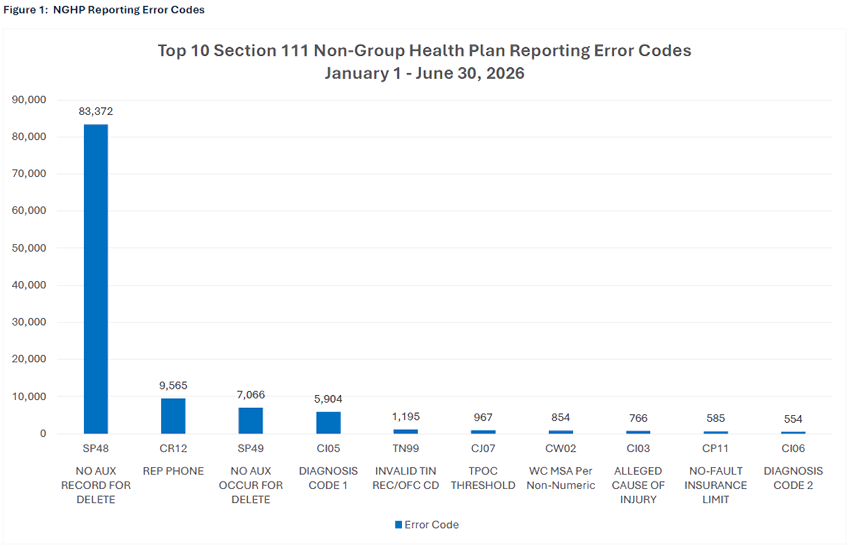
The two-page report contains Figure 1 – NGHP Reporting Error Codes, a bar chart of the ten most frequent error codes, followed by Table 1 – Error Code Descriptions on the second page. The ten error counts shown in the chart total 110,828.
Top 10 Error Codes
The error codes and counts from Figure 1, with descriptions taken from Table 1, are as follows:
| Rank | Code | Description | Error Count |
| 1 | SP48 | No matching record for submitted delete transaction (chart label: No Aux Record for Delete) | 83,372 |
| 2 | CR12 | Invalid Representative Phone Number | 9,565 |
| 3 | SP49 | No matching record for submitted delete transaction (chart label: No Aux Occur for Delete) | 7,066 |
| 4 | CI05 | Invalid Diagnosis Code 1 | 5,904 |
| 5 | TN99 | No matching, valid TIN Reference File Detail Record for the TIN/Office Code combination | 1,195 |
| 6 | CJ07 | Invalid TPOC Threshold: ORM Indicator = N and cumulative total of submitted TPOC amounts is zero | 967 |
| 7 | CW02 | Invalid MSA Period | 854 |
| 8 | CI03 | Invalid Alleged Cause of Injury, Incident, or Illness | 766 |
| 9 | CP11 | Invalid dollar amount of limit on no-fault insurance | 585 |
| 10 | CI06 | Invalid Diagnosis Code 2 | 554 |
Our review of this updated set of top error codes produced several observations, some of which continue to roll forward from previously published lists:
-
- The data shows a major increase in SP48 and SP49 errors, but there is a known processing issue that CMS has acknowledged. When IMPAXX began to receive these errors, we were able to quickly determine that no ‘delete’ transaction was ever sent for the claims receiving those errors. After checking with the BCRC we were informed that a code change was the issue and that a disposition code of 01 or 03 should have been received.
While we can see the total errors for these codes, what remains unclear is how many of them should never have been returned versus the actual count of valid errors.
-
- Soft errors are still being represented in these counts. Both CR12 and CI03 are soft errors and will not cause rejection of the claim.
- ICD Diagnosis codes remain a top reason for claim rejections with other hard error rejections coming from TIN records, TPOC thresholds, MSA periods, no-fault limits, and other ICD code slots.
While it appears that many of the errors are outside of the Responsibility Reporting Entities’ (RREs) control, there remains a significant number of hard errors that can be handled through a data validation process before submitting to CMS.
If you have questions regarding this article or would like to explore how using a reporting partner can help alleviate submitting bad data to CMS and decrease the risk of noncompliance, please do not hesitate to email our experienced MSP Reporting services team at [email protected]. If you are looking for further guidance on Section 111 reporting compliance, our experienced Medicare Secondary Payer Reporting services team can collaborate with you to customize the compliance experience to meet your unique needs and requirements.